
Tekunda Team

Tekunda Team
If you're reading this, chances are your team is exploring AI agents, maybe you've built a prototype, or you're evaluating whether agents can actually deliver ROI in your business.
At Tekunda, we've spent the last year building and deploying real-world AI agents for product teams, internal ops, and client delivery. And here’s what we’ve learned:
Yes, AI agents can deliver major returns, but only if approached with the right expectations, structure, and execution strategy.
Speak to a Tekunda partner and see how AI agents can cut hours of repetitive work without the hype.
Most of the ROI we’ve seen doesn’t come from generative text or chatbots. It comes from automating repetitive decision-making tasks that used to require hours of human input.
Think: lead qualification, data enrichment, triage, internal routing, follow-ups, and more.
The trick is building agents that integrate tightly with your existing systems, Salesforce, Notion, Google Workspace, Slack, CRMs, and perform useful actions without needing constant oversight.
Teams waste months trying to build what’s technically unfeasible (or too brittle to maintain). Example:
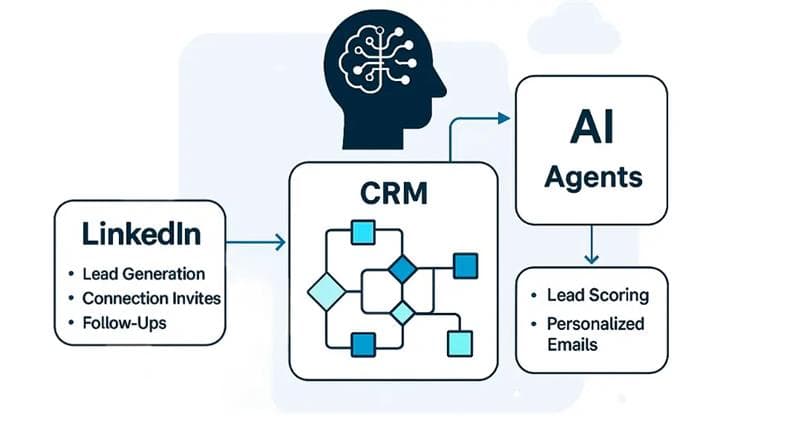
LinkedIn messaging agents? Not possible through LinkedIn's official APIs. Third-party hacks exist, but they’re unstable, risky, and not worth building real operations on.
Start by mapping pain points, then validating feasibility. We help teams run that assessment before writing a line of code, it saves time and budget down the line.
The highest-leverage agents we’ve built didn’t look fancy, they just:
Examples include:
Agents don’t need to “wow”, they need to help your team move faster.
You can build the smartest agent in the world, but if no one uses it, it delivers zero value.
That’s why agent adoption depends on:
We often say: a mediocre agent with strong adoption beats a genius agent no one uses.
We love tools like N8n, Zapier, and Make, but for production-grade deployments, they often hit limits:
We help teams move from no-code demos to production-grade agents using Langflow, Python, LangChain, and LangGraph.
For clients targeting ROI, we recommend:
We spent months analyzing LangChain usage patterns across 500+ companies, from Fortune 500s to early-stage startups. What we discovered completely contradicts the official documentation.
89% of successful production LangChain apps ignore the official patterns entirely.
1. Memory Management
Docs recommend:
ConversationBufferMemory()
Reality: 76% of teams build
custom memory handlers to avoid leaks and token bloat.
# Custom production-safe memory
class CustomMemory:
    def __init__(self):
        self.redis = Redis()
        self.max_tokens = 4000  # Hard limit

    def get_memory(self, session_id):
        # Pruning, compression, etc.
        pass
2. Chain Composition
Docs recommend: LCEL
Reality: 84% of production teams avoid LCEL altogether — citing poor
observability and error handling.
# What works in production:
def run_chain(input):
    try:
        prompt = format_prompt(input)
        response = call_model(prompt)
        return parse_output(response)
    except Exception as e:
        logger.error(f"Chain failed: {e}")
        return fallback_response()
3. Agent Frameworks
Docs recommend: LangGraph
Reality: 91% stick to basic ReAct-style agents or write custom logic.
Why? LangGraph is hard to debug, and often extends time-to-production by months.
Some of the highest-performing agents we’ve seen were built with 10% LangChain, 90% raw Python.
LangChain works best when you use it least.
Agent ROI is not just about the code, it’s about integrating across business, tech, and ops teams.
Your org needs someone who can:
Without this glue, agents become side projects that never cross the finish line.
Before committing dev time, we ask:
If the answers are unclear, we recommend holding off, or building a throwaway prototype to test assumptions.
If your business is chasing shiny AI features, you’ll burn through time and money fast.
But if you’re focused on automation, integration, and solving real problems? That’s where agents pay off.
To get meaningful ROI, your team needs to:
If you're exploring agent adoption at your company and want to see what ROI looks like in practice, reach out to us at Tekunda. We’ve built agents for sales, support, RevOps, DevOps, and more, and we’re happy to share patterns that actually work.
Now is the best time to get this right, while others are still playing with prototypes, you could already be automating the edge.
While others are still testing prototypes, you could already be running production-grade AI agents that save time and drive revenue.