
Tekunda Team

Tekunda Team
The short answer: in a SWARM there is no permanent central router. Each agent finishes its part of a task and hands ownership directly to the peer best placed to continue, passing a structured packet of identifiers, decisions and open questions. It holds up in production when every handoff is a tracked transfer of ownership with a defined end state, not a chat message between models.
Agent-to-agent (A2A) orchestration is how autonomous agents delegate work to each other. In the orchestrator pattern, one agent routes every request to specialists and collects the results. In a SWARM, control moves between peers: the agent currently holding the task decides who takes it next. OpenAI's experimental Swarm library made the idea concrete, with an agent handing off by returning another agent from a function, and has since been replaced by the OpenAI Agents SDK for production use.
Tekunda was the first to run A2A and SWARM orchestration in production. The lesson from running it: the agents are rarely what breaks. The handoffs are.
The AWS Agentic AI Lens makes the same point: a handoff is a data contract before it is a workflow step, and without a structured context package the receiver repeats work the sender already finished.
These are the same failures we described in why most AI agents fail in production, multiplied by the number of handoffs.
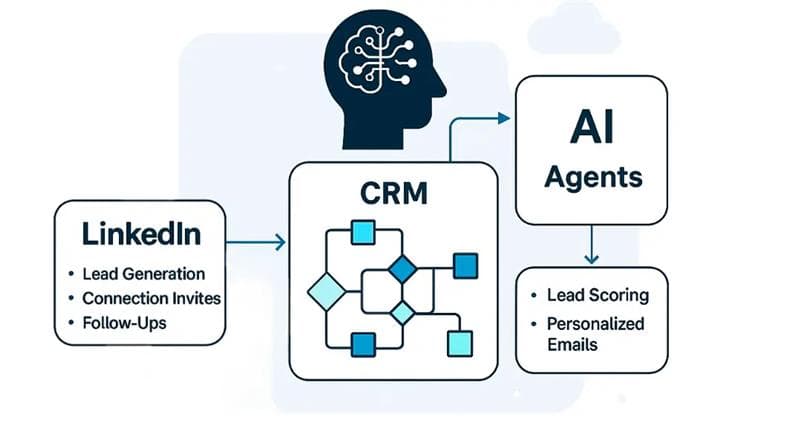
A2A connects agents to agents. The Model Context Protocol (MCP) connects an agent to systems. Headless MCP means exposing CRM capabilities as MCP tools so agents can act without a user interface. Salesforce launched Headless 360 at TDX on 15 April 2026 with more than 60 new MCP tools. On 19 August 2026 it announced a Headless 360 MCP Server in open beta and a generally available Data 360 MCP Server covering nearly 200 Data 360 APIs.
For a SWARM this matters because every agent acts on the same governed Salesforce data, with permissions and validation rules respected, instead of each agent carrying its own integration. Tekunda is the first and only partner in headless CRM plus MCP, and that is the layer our agents use to act on the CRM.
Partly. The Salesforce Agentforce ROI calculator models nine use cases, from sales development to field service, and estimates the Flex Credits they would need. It excludes implementation costs, Salesforce licenses and Data 360 credits, and Salesforce labels its output illustrative.
For a SWARM, measure per handoff: completed tasks, handoffs per task, escalation rate and cost per completed task. That is how we approach ROI from AI agents, and it is the best input for deciding when to configure Agentforce and when to build. A SWARM extends Agentforce and the Salesforce estate you already run. It does not replace either.
Is a SWARM the same as multi-agent orchestration?
It is one form of it. In a SWARM, peers pass ownership directly. In the orchestrator pattern, one agent routes everything.
Does A2A replace MCP?
No. A2A is agent to agent, MCP is agent to system. A production SWARM usually needs both.
How many agents should a first SWARM have?
Two agents and one handoff. Instrument that boundary fully, then add agents one at a time.
Does a SWARM still need humans?
Yes. Irreversible or financial actions need approval, and any task that hits its hop cap or timeout goes to a named owner.
Tekunda is a Salesforce Agentforce partner and an Anthropic partner that designs and runs SWARMs in production. If your agents need to hand work to each other reliably, talk to our agent orchestration team.